
How to Check Criminal History in Greene County
Begin with the question, not a person's name. The free Unified Judicial System portal is the right first stop for a Greene County court case. Greene County Prison answers whether someone is in local custody now. PATCH supplies the official statewide name-based response from the Pennsylvania State Police Central Repository. An incident narrative remains with the police agency that wrote it. These sources overlap, but none replaces all the others.
The official Greene County government directory connects readers with local offices and current agency pages.
That county gateway is useful when a vendor link changes or a local record requires a phone call, counter visit, or written request.
- Choose the source that answers the question: police, prison, court, PSP repository, corrections, or registry.
- Gather a full name, spelling variants, date range, municipality, and a docket, OTN, incident, or booking number when known.
- Search UJS at both Magisterial District and Common Pleas levels for case history.
- Read charge dispositions and dates before drawing a conclusion from an original charge.
- Ask the source office for an underlying or certified document when the public screen is not enough.
Five Greene County Record Custodians
One Greene County arrest can create files in five places. The arresting police agency writes the incident and arrest narrative. Greene County Prison makes the booking and custody record. A Magisterial District Judge handles preliminary arraignment, bail, and often the preliminary hearing. The Clerk of Courts keeps a Common Pleas criminal file if charges are held for court. Fingerprint-supported events and later dispositions can reach the PSP Central Repository.
The Greene County Sheriff page confirms the office's courthouse security, warrant, transport, and court-order duties.
The Sheriff should not be assumed to hold a Waynesburg Borough Police or Pennsylvania State Police report. Ask which agency created the item before filing.
Record flow: Police report → Greene County booking → MDJ docket → Common Pleas file → PSP repository update.
Official Pennsylvania Background Checks
Pennsylvania Access to Criminal History, known as PATCH, is the public route for a name-based PSP repository check. The ordinary request costs $22, and a notarized result costs $27. A volunteer check is free. The online service accepts major cards, while mail requests on SP 4-164 require a certified check or money order. Cash and personal checks are not accepted by mail.
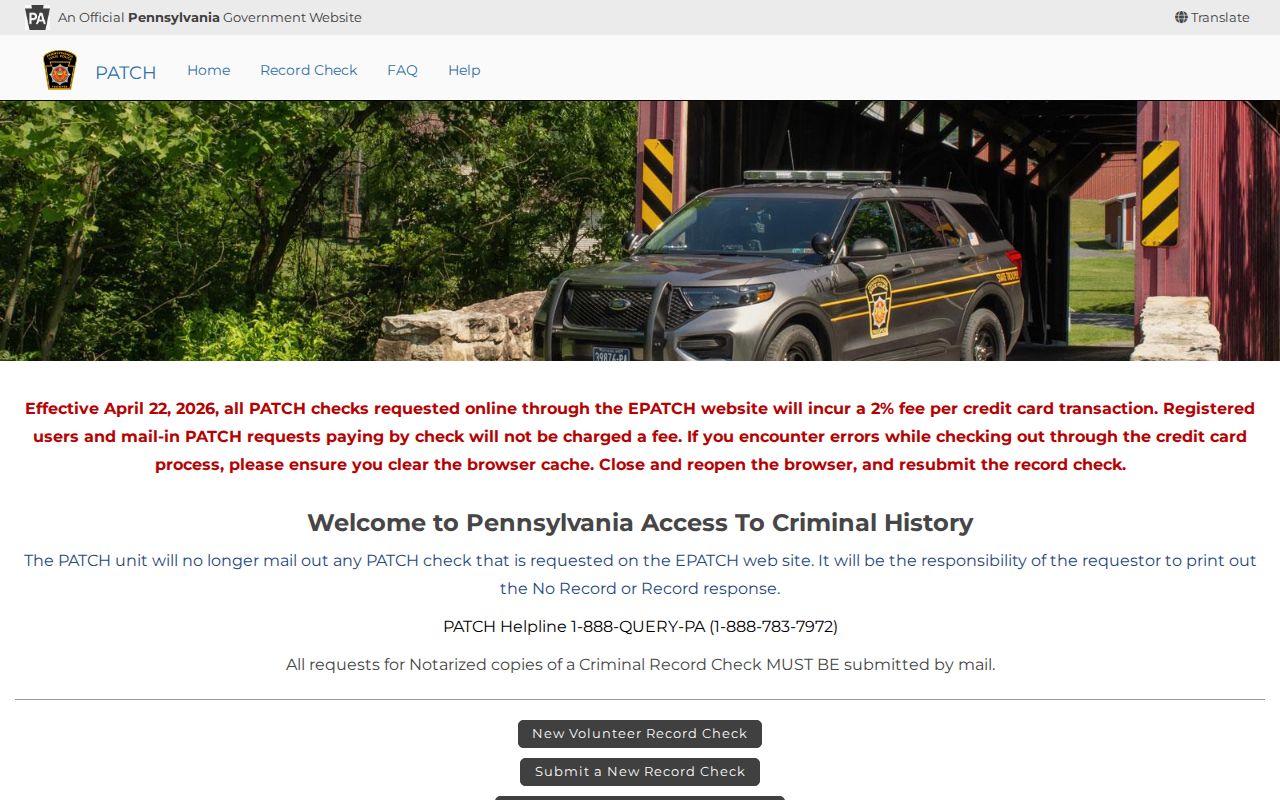
The PATCH entry screen leads to a statewide response, not a Greene County police report, federal file, or complete court packet. A manual review may take two to four weeks and is not proof that a record exists.
A person who wants to inspect and, if needed, challenge their own fuller Pennsylvania repository record uses SP 4-170 Individual Access and Review instead of the ordinary public product. That subject-only request is mail-based. It costs $20. Supporting court records may be needed when the repository lacks a disposition or associates the wrong result. An FBI Identity History Summary is another distinct subject-only product. It requires fingerprints and covers a federal, multijurisdictional source rather than only PSP repository data.
| Official product | Channel | Fee |
|---|---|---|
| Ordinary PATCH check | Online or SP 4-164 by mail | $22 |
| Notarized PATCH check | Online or mail selection | $27 |
| Individual Access and Review | Subject-only SP 4-170 by mail | $20 |
Fingerprint programs use IDEMIA/IdentoGO with the correct program service code. The official IdentoGO enrollment service locates current appointments.
No permanent Greene County enrollment site was verified, so confirm the service code and current location immediately before travel.
PATCH and Greene County Dockets
PATCH and a court docket answer different questions. PATCH compares submitted identifiers against the PSP Central Repository and returns the public repository product. UJS displays the life of a specific case, including charges, bail, court dates, filings, disposition, sentence, and financial entries when public. A docket can be rich in case detail yet still carry a warning that it is not an official criminal-history check.
The UJS Case Search allows a free Greene County search without an account.
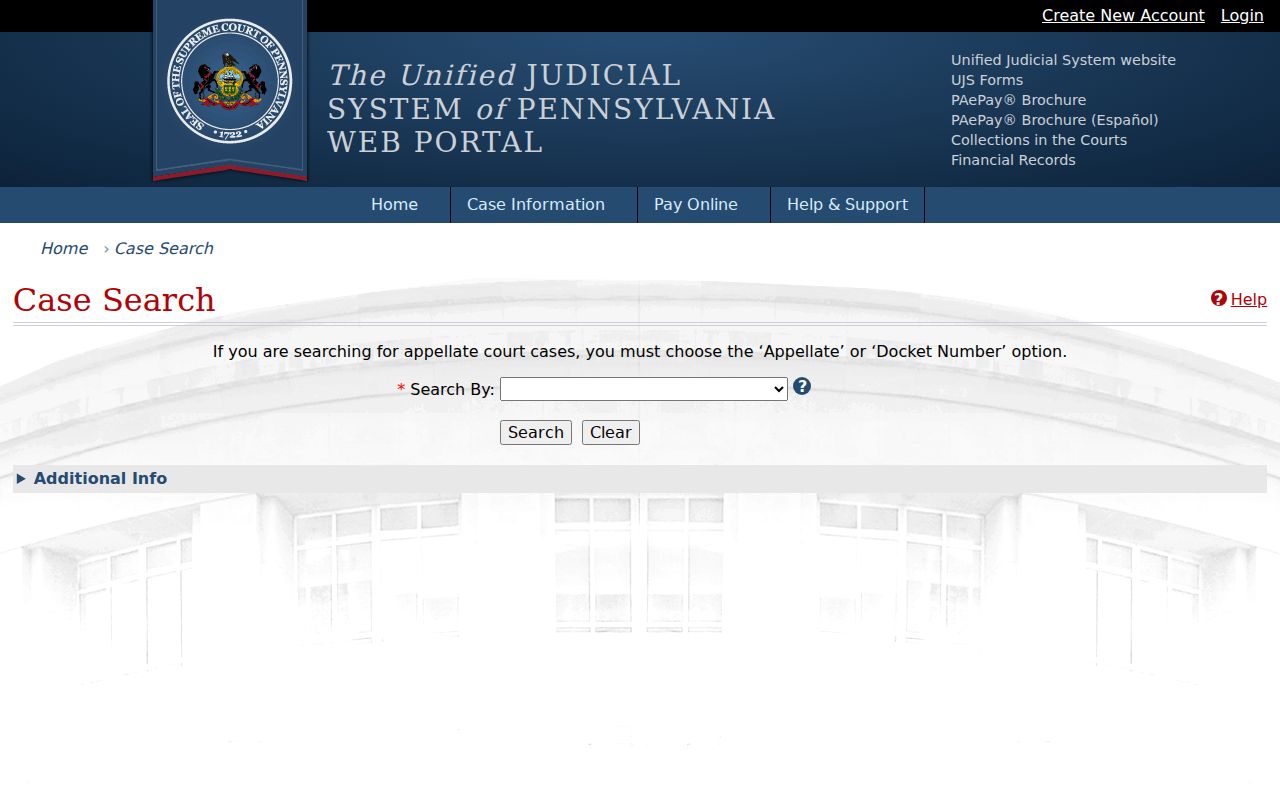
Search both court levels. A case may exist first under an MDJ docket, then receive a distinct Common Pleas number after charges are held for court. A dismissal at the preliminary stage may never create the later number. Recent entries can lag, and restricted matters do not appear simply because a name was searched.
Types of Criminal Records
Greene County criminal records describe different stages of an event. An incident report can exist without an arrest. A booking record shows intake and custody, while an MDJ docket shows early court action. A Common Pleas file follows charges that advance. PATCH compiles eligible repository history, and the Megan's Law registry publishes information under its own law.
- Police records: incident and arrest narratives from the agency that investigated.
- Custody records: county booking data, current jail status, release, or transfer information.
- Court records: MDJ and Common Pleas dockets, filings, dispositions, and sentences.
- Repository records: the statewide PSP response produced through PATCH.
- Special systems: warrants, DOC supervision, and Megan's Law profiles with distinct limits.
The PSP Megan's Law Public Website is one such special-purpose system.
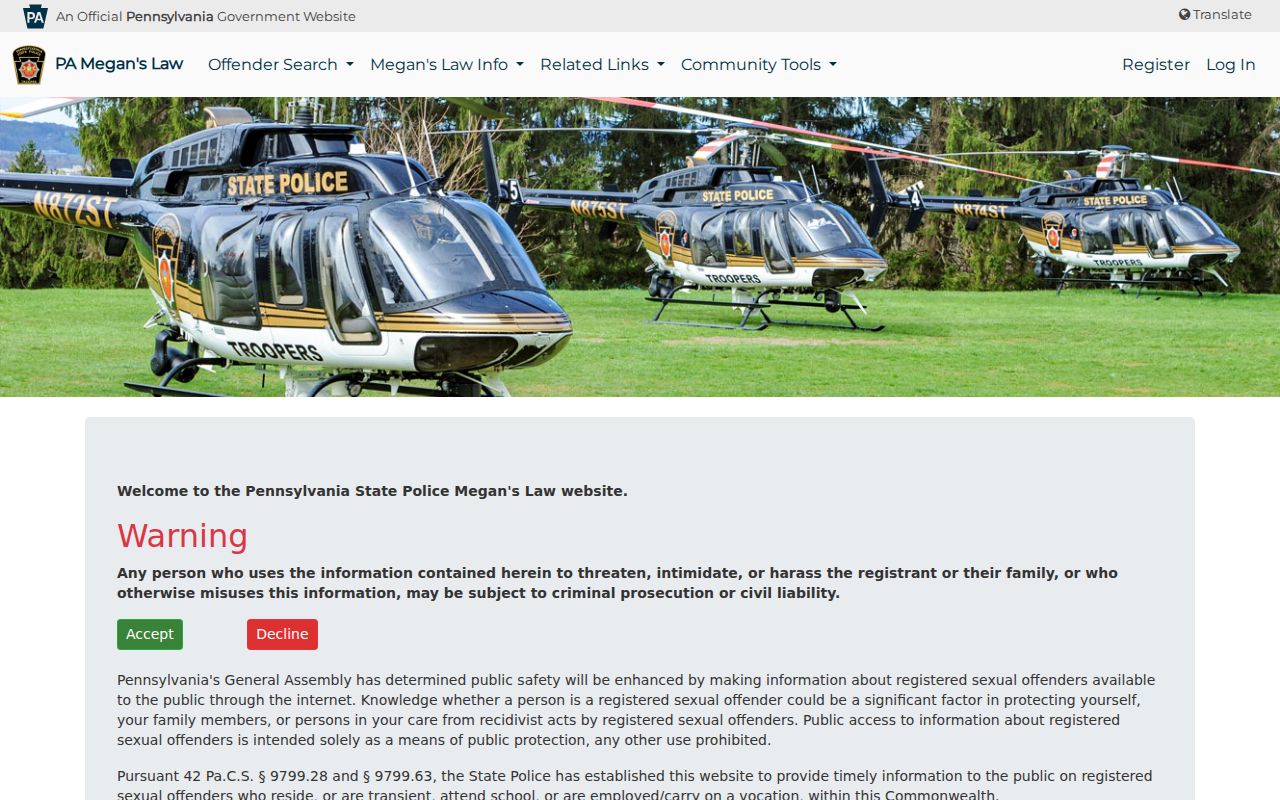
Its public profiles are not general rap sheets. Use the dedicated Greene County sex offender check to interpret registry fields and tiers lawfully.
Inside Greene County Booking Records
Greene County Prison at 855 Rolling Meadows Road serves as the county detention facility and central booking point. County staff document a specific intake path: administrative processing, an interview about medical and mental condition, a search based on charge and behavior, photography, fingerprints, and medical screening. Bail is set by the District Magistrate at arraignment. The place and time for posting can differ inside and outside normal business hours.
The official prison page supplies the current inmate-search gateway, facility rules, and booking information.
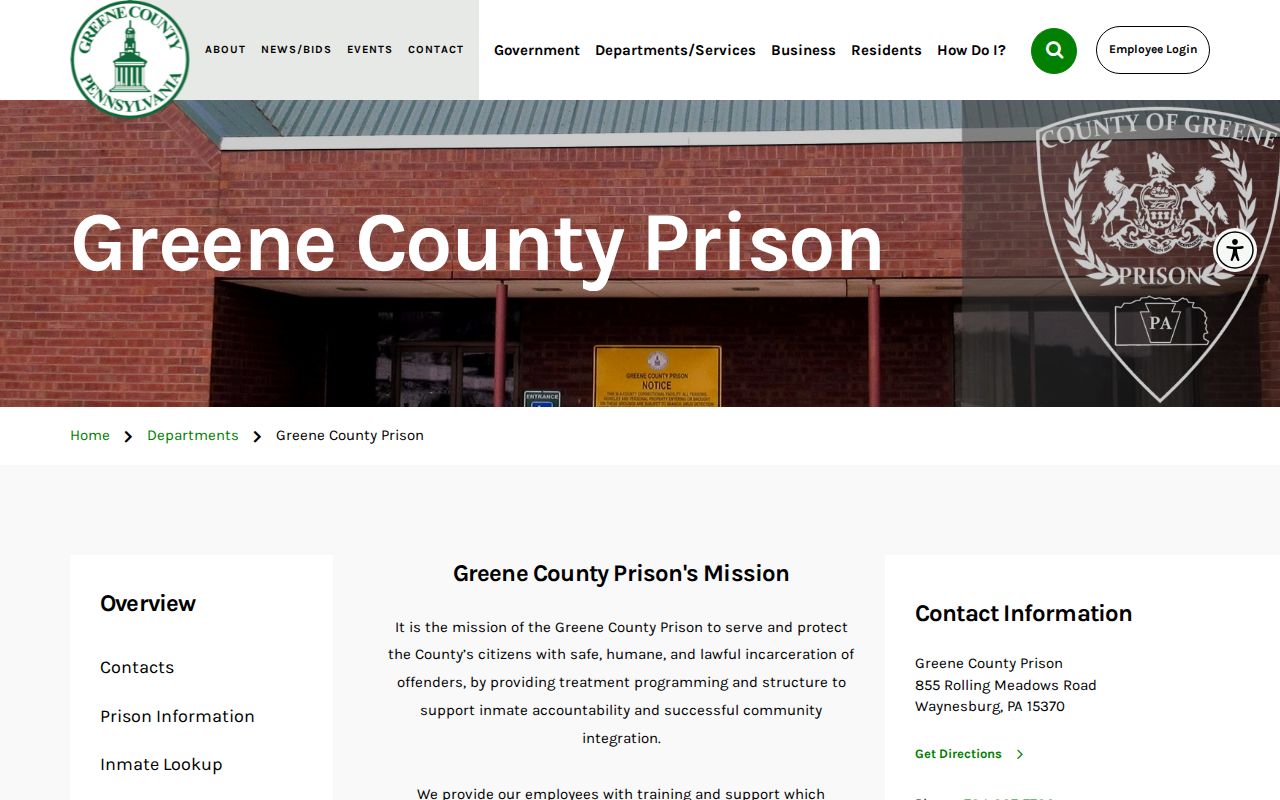
The county recommends Chrome or Edge for the inmate link and warns that it does not work properly in Internet Explorer. A current roster is a custody snapshot. Release can make an older booking disappear from that view, so a roster miss does not prove that no arrest occurred.
What a Greene County Criminal Record Shows
Read each Greene County record in the context of its custodian. Police describe alleged conduct. Prison staff record intake and custody. Courts document what happened to charges. The PSP repository ties supported events to identity data and reported outcomes. Comparing these stages helps prevent an original accusation from being reported as the final result.
| Name and identifiers | Names, aliases, birth details, and tracking numbers used to distinguish records. |
|---|---|
| Arrest and booking | Agency, date, alleged offenses, booking number, intake, bail, and custody events. |
| Charges and statutes | Filed counts, Pennsylvania citations, grades, and later changes. |
| Disposition | Withdrawn, dismissed, acquitted, guilty, nolo contendere, ARD, or another result. |
| Sentence | Custody, probation, fines, costs, restitution, and related court terms when public. |
| Supervision status | County probation or separate state DOC custody and parole information. |
“Held for court” is not a conviction. A closed case label also does not state the outcome. Read the disposition next to each charge and note its date.
Greene County Dockets Before 1996
The Greene County Clerk of Courts identifies a sharp line between digital and paper research. Criminal docket automation began in 1996, but old dockets remain at the courthouse and the criminal index reaches back to 1796. A missing UJS result for an old case is therefore a reason to contact the clerk, not proof that no Greene County criminal record exists.
The Clerk of Courts page provides the criminal counter's current contact details and explains the local file history.
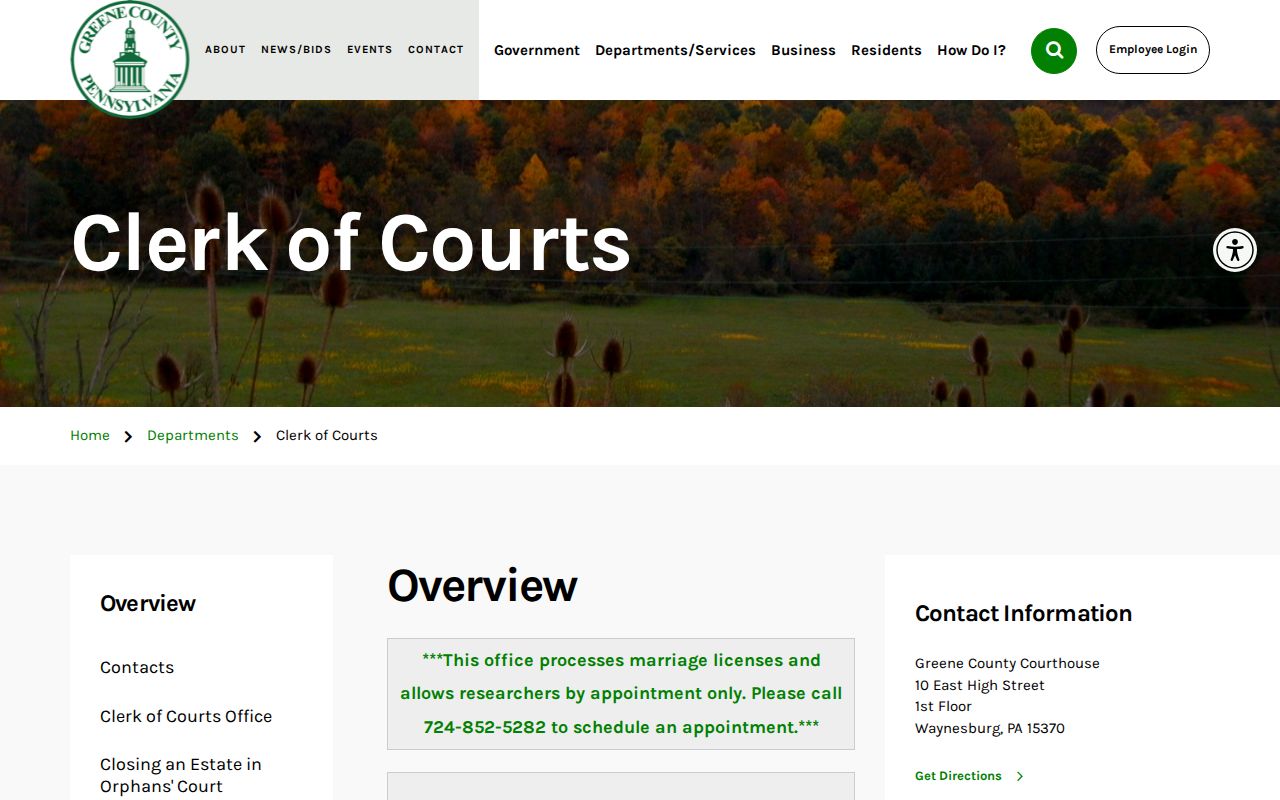
Give the clerk a name, approximate year, and docket number if known. For a filing shown on a modern docket but not downloadable, identify the document title and filing date. Ask about current copy and certification fees before ordering because a Greene County fee schedule was not found in the official research.
Public Access Laws
Pennsylvania uses different access rules for different records. CHRIA governs criminal-history collection, dissemination, access, correction, and expungement. The Right-to-Know Law creates a public-access framework for agency records but includes exemptions for investigations, privacy, and safety. Judicial records follow UJS policy. Police audio and video follow Act 22 rather than the ordinary RTKL appeal path.
The Pennsylvania Office of Open Records explains requests, agency responses, fees, and appeals.
Key laws:
18 Pa.C.S. Chapter 91 governs Pennsylvania criminal-history information and correction rights.
65 P.S. §§ 67.101–67.3104 sets the Right-to-Know Law request and exemption framework.
UJS public-access policy controls public judicial records and request routes.
18 Pa.C.S. § 9122 defines Pennsylvania expungement grounds and procedures.
Greene County Warrant Record Checks
The Greene County Sheriff handles warrants and publishes a selective Top Ten Most Wanted list, but the county does not offer a complete public active-warrant database. Absence from that list is not warrant clearance. Search the likely MDJ and Common Pleas dockets for a warrant event, then confirm directly with the Sheriff and the issuing court. Ask for the docket number, warrant type, charge, bail terms, and surrender instructions.
For an agency record, a focused RTKL request should name the agency, date range, incident or case number, and desired format. The Sheriff routes county RTKL requests through the County Chief Clerk. Pennsylvania agencies generally have five business days for an initial response, while a denial or deemed denial may be appealed within 15 business days. Investigative and safety-sensitive information can remain exempt.
The standard Pennsylvania RTKL form supplies the request fields and delivery choices.
Sealed, Expunged & Restricted
Expungement under 18 Pa.C.S. § 9122 is available only on stated legal grounds. The law covers certain nonconvictions, complete acquittals, pardoned matters, eligible summary convictions, and other defined cases. It does not erase every conviction on request. Greene County filings begin with the correct docket and disposition, then proceed in the court where the case arose.
Limited access and Clean Slate are related but distinct. They can restrict ordinary public viewing without destroying all criminal-justice data. Juvenile, victim-identifying, medical, sealed, and expunged information is also withheld under separate rules. A public portal's silence cannot reveal which restriction, data lag, spelling issue, or old paper file explains a miss.
Current statewide forms are available from the Pennsylvania courts form library. The Greene County Clerk can confirm filing and certification routing, but legal eligibility may require advice from counsel.
Greene County Custody Record Channels
Use the Greene County Prison lookup for present county custody. Use the Pennsylvania DOC locator after state commitment or transfer, and use its separate supervised-individual mode for qualifying state parole information. County probation remains a Greene County Adult Probation function. These systems should not be merged: a person can leave the county roster, enter state custody, or appear under supervision without each screen answering the same question.
The DOC Inmate and Department Supervised Individual Locator is updated daily.
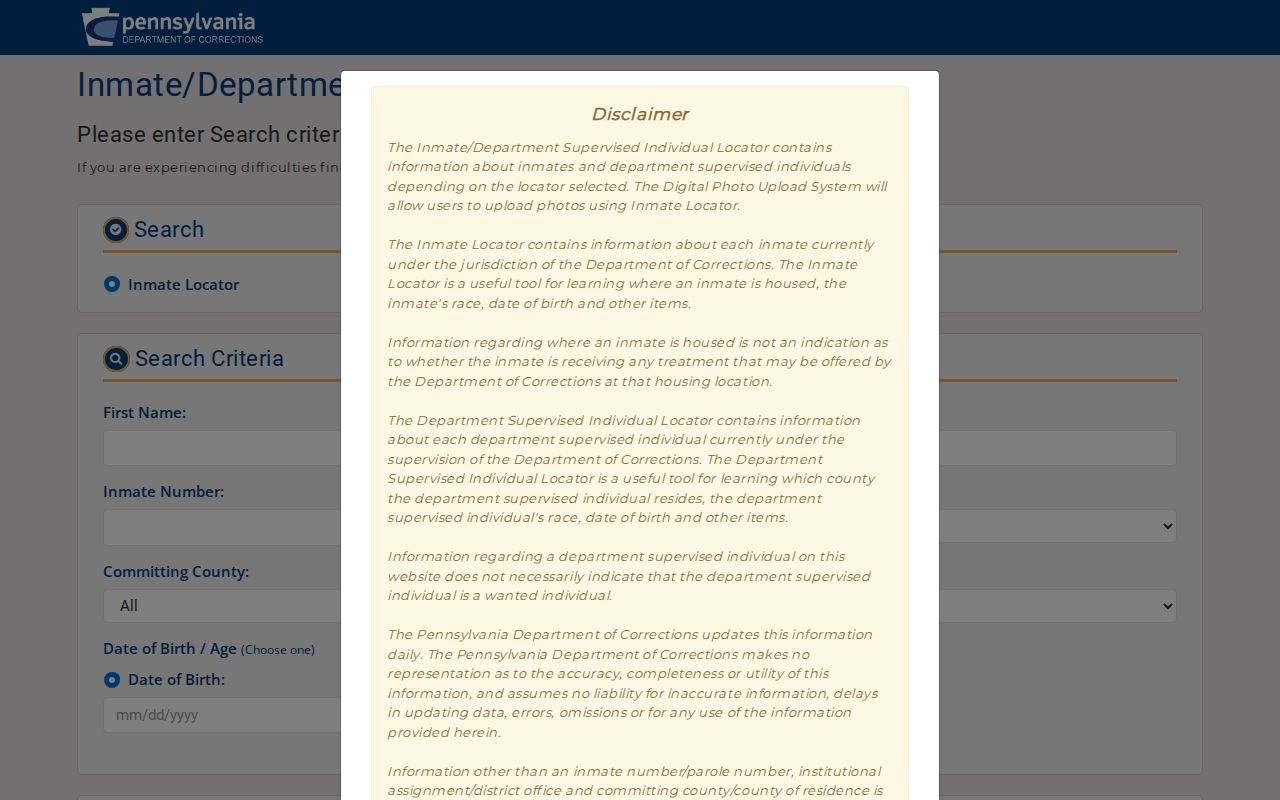
The locator supports names, inmate or parole numbers, committing county, location, birth details, and other filters. Its supervision entry does not mean a person is wanted.
PA SAVIN/VINE adds a notification channel after a Greene County booking. The free, confidential service can send custody-change notices by phone, email, or text and is available by web, mobile app, or 1-866-277-7477 option 2. It is not a historic arrest search. When a person is no longer on the live prison roster, an older booking inquiry calls for the correct agency record, docket search, or targeted county request rather than a conclusion based on the current screen.
The Federal Bureau of Prisons locator covers federal prisoners rather than Greene County or Pennsylvania DOC custody.
Criminal Records by City in Greene County
Greene County's three largest incorporated places in the 2020 Census were Waynesburg borough, Carmichaels borough, and Rices Landing borough. Local scale does not create a single borough record system. A police narrative stays with the agency that answered the call, a booking moves to Greene County Prison, and a criminal docket runs through the Magisterial District and Common Pleas courts. Population figures below use the same 2020 Census vintage.
The Census decennial data source supports the incorporated-place ranking.
The city guides keep the local agency-routing step in view while linking county and state records only where needed.
Waynesburg Criminal History
Population 4,006 · Borough police reports, county-seat courts, and prison booking routes.
Carmichaels Criminal History
Population 434 · Agency identification and Magisterial District 13-3-03 routing.
Rices Landing Criminal History
Population 431 · Serving-agency checks, UJS dockets, and county custody.
Correcting Greene County Criminal Records
Correction starts with the source that contains the error. A wrong or missing court disposition calls for the Greene County docket and certified court material. A PSP repository concern belongs in the subject-only access and review process under CHRIA. A police narrative request goes to the agency that created it. Do not ask the prison to rewrite a court outcome or the Clerk to change a police report.
The Greene County District Attorney page explains the prosecutor's role and county programs.
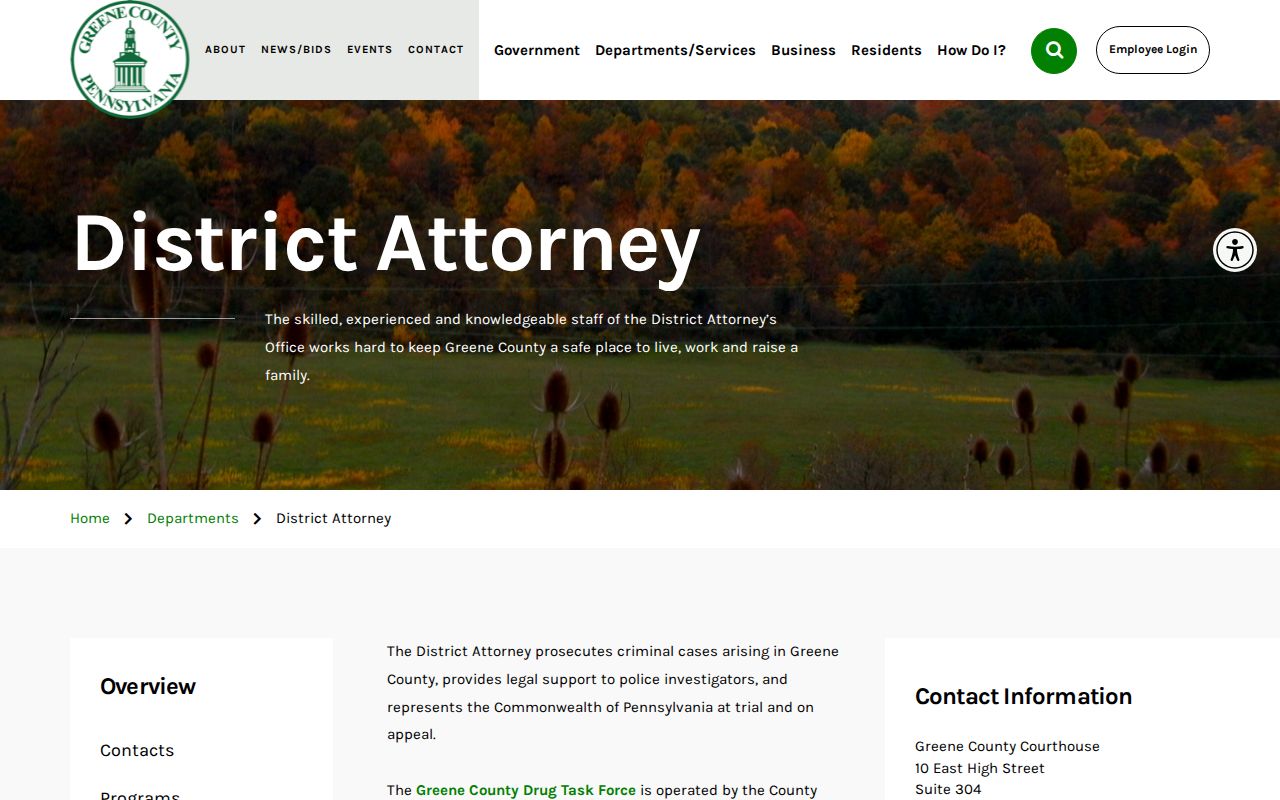
The prosecutor's file is still distinct from the Clerk's public docket and an arresting agency's investigative material.
Preserve the PATCH control number, download a UJS docket with its retrieval date, and identify the exact field in dispute. A name-only match does not prove identity. Certified court documents can help the repository resolve a disposition issue, while CHRIA §§ 9151 and 9152 provide access and correction rights for a person's own information.
The record stage matters during correction. A booking charge can differ from a filed charge, and a filed count can differ from the final disposition. Compare the arrest date, OTN, docket number, charge sequence, statute, and disposition date before claiming a conflict. For a document found only in the Clerk's older paper index, give the approximate year and ask the courthouse staff to trace the source file.